Creative Critical Reflection – Final Film

  1. How do your products use or challenge conventions and how do they represent social groups or issues? Our film uses its two main characters in order to create a gay stereotype that is rarely used in horror films. Inside of our gay couple, Chad is a gay-closeted, football player whilst Angel is an openly gay character. Chad is used to fluently illustrate the feelings that closeted-gay men and women have towards society this day and age. Overall, the two main characters actions emphasize how certain groups must act a specific way in order to get a positive reaction from society. By taking a common film-genre and integrating an uncommon stereotype, we were able to successfully challenge some conventions and issues.

2. How do your products engage with the audience and how would they be distributed as real media products? Though we do not offer much material item that relates to our final film, we engage the audience with the film itself by using film techniques, editing, and camerawork to retain the audiences attention. It is key that this principle is kept throughout the filming and editing of the film since diverting can cause loss of audience and fans. The distribution of the film itself would be primarily digitally unless it must be done physically such as through DVD.

3. How did you integrate technologies – software, hardware and online – in this project? Technologies such as the ones just mentioned were applies and integrated into our project through one simple way, ‘editing’. Visual editing was done the freeware, or software, that is called ‘Hitfilm Express’. Sounds were also linked off of a website known as ‘freesound’. Overall, this film would have been heavily dented without the use of the internet.

4. How did your production skill develop throughout this project? Throughout the project, our technological aspect stayed the same. It was at quite the decent level from beginning to end so we had nothing to complain about, On the other hand, our communication skills were lacking in that we were not properly conveying what we meant from the beginning. As time passed though, we learned to work together and not individually and how to be more detailed and specific with requests.

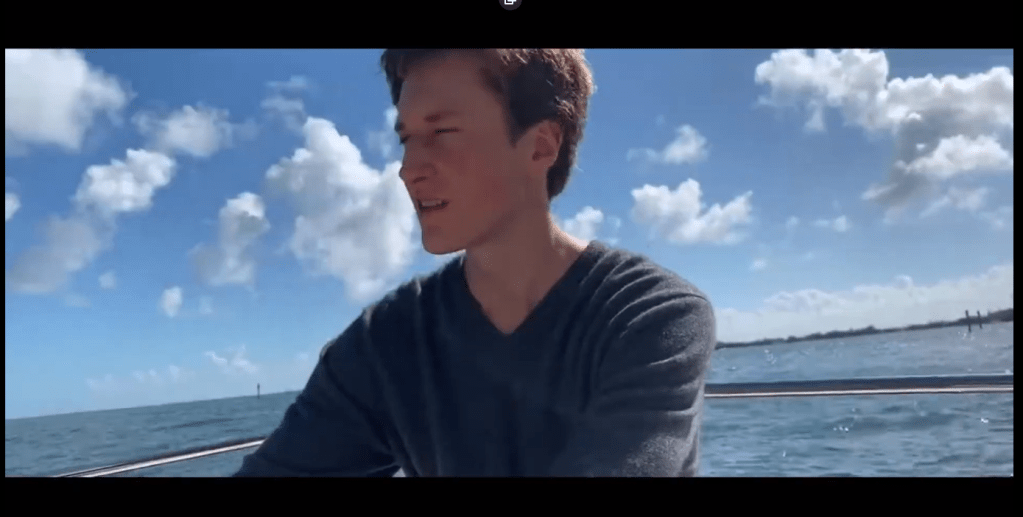
Discussing our Final Film

  1. Rate on a scale from 1-10 how did your group work as a team. Support your rating. What could have made it a 10? I think that out of ten, we most likely score a 6. I believe we scored this much because there were times when our communication skills were flawed and things were lost in translation. Apart from that our visions were not completely the same and one has to adapt to everyone liking on order for something to work and so we did. What could have made it a ten was a more physical experience with each other to talk things and sort things out.
  2. Explain how you organized and prepared for the project. What went well and what could have been improved? To organize and prepare for the project, we created multiple group chats and discussed our future plans among ourselves and separate actors. Some of us scouted for locations and new crew members whilst others edited the film and choreographed the cinematography.
  3. What difficulties did you encounter when filming? How did you overcome them? The corona-virus was a relatively new situation when we started filming, so we were able to get a good amount of the clips done. Once the filming was done we were ordered to stay inside of our homes and so in turn we weren’t able to revise any of the clips or discuss it physically. To overcome this we had to constantly text each other and join zoom meetings online to organize where we were and how to advance.
  4. What difficulties did you face when editing? Only one difficulty was faced while editing the film and that was the lack of clips for some of the scenes. Since some of the clips were either too short or too long I had to take the video from some clips and match it to the audio of another re shoot that didn’t have audio problems. Apart from that, minor wind interfered with our audio and we weren’t able to re-do any audio during post.
  5. Discuss how you prepared for the audio of your film? We didn’t have enough time to prepare for the audio of the film so in turn we were forced to use the iPhone camera built-in mic. This provided us with a couple of obstacles such as wind interference and low quality values. I was able to tweak and denoise some of the audio in post yet I am still unsatisfied with the results.
  6. If you were to repeat the project again what would you do differently? If I were to repeat this project again I would most likely change up how we organized the filming. I would have asked them to do multiple shots and revise their shots in order to not have to work with the bare minimum I was given.
  7. Analyzing the final production, what aspects are you happy with? What could have been improved? I’m very happy with the editing portion of the film, I believe that the masked text (Motion Graphics) was done quite well compared to our audio (SFX).I still firmly believe that the audio could be heavily improved.

Editing – Final Film

Hitfilm Express Doesnt fit my Screen correctly — FXhome Forum
Hitfilm Express

The final shots were recorded and sent to me for editing during spring break and I completed with time remaining.

There were multiple shots given to me with a variety of angles and audio clips for me to choose from. Though I did have a fairly easy job on my hands, I later found out it wouldn’t be the easiest task of them all.

Some of the clips, I discovered, had been filmed wrong whilst other clips had wrong audio pieces. Instead of avoiding the clips completely, I engineered my way around by combining broken clips and broken audios to form an understandable video clip. other complications such as windy sound over the mic used had to be looked into by me. Unfortunately, I was not able to de=noise the audio and I find that to be my biggest regret of the film.

As for the color grading, the camera that my team member used had already done a good job of capturing the correct colors, yet it still needed some tweaking. For every single individual clip, I required adding small amounts of color-splashes here and there, and also letter box bars at the top and bottom of the video.

Overall, the results were better than expected given our current situation and what I was given to work with. I am more than happy with what I made and what my team-members made. The only thing I wish I could have worked on/regret was audio. I believe I could have done a better job de-noising and leveling out my audio.

Story Board – Final Film

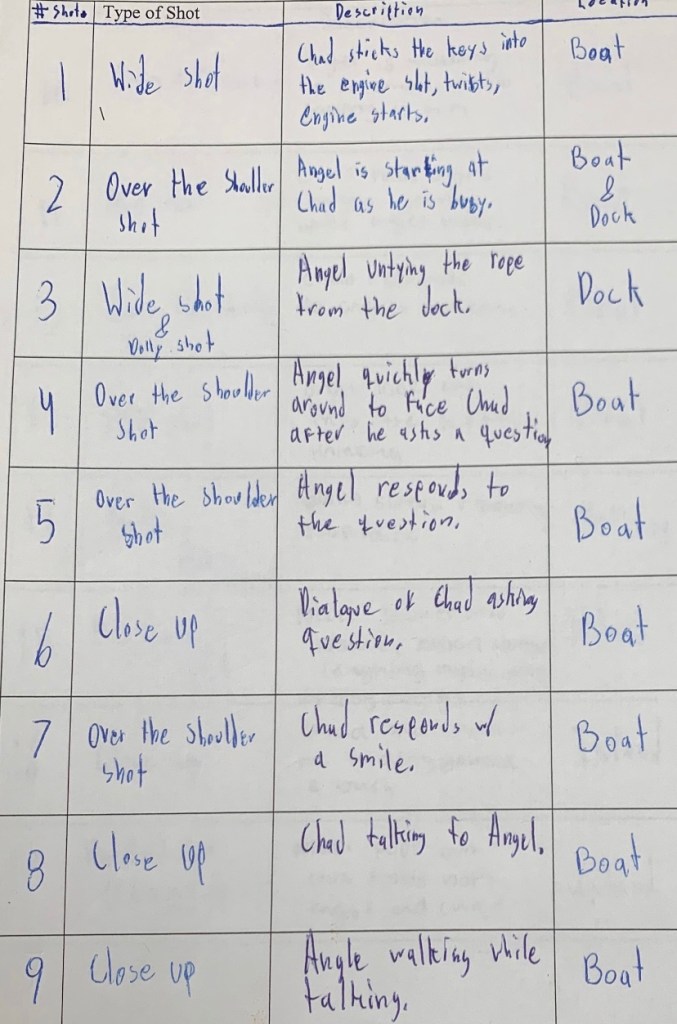
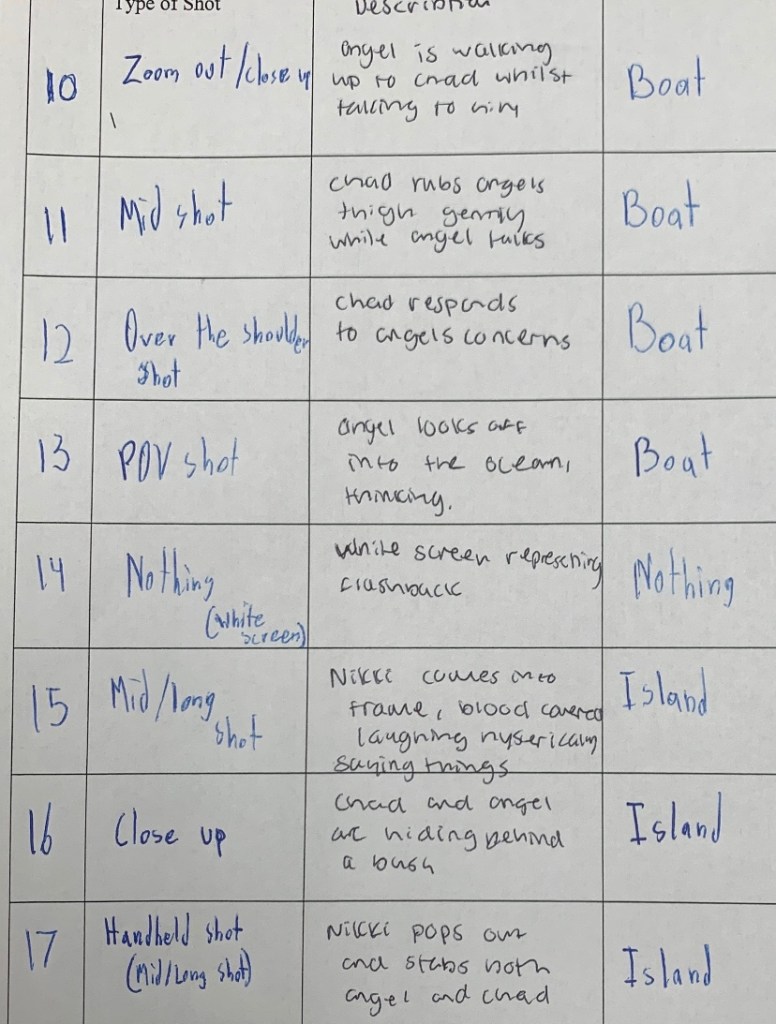
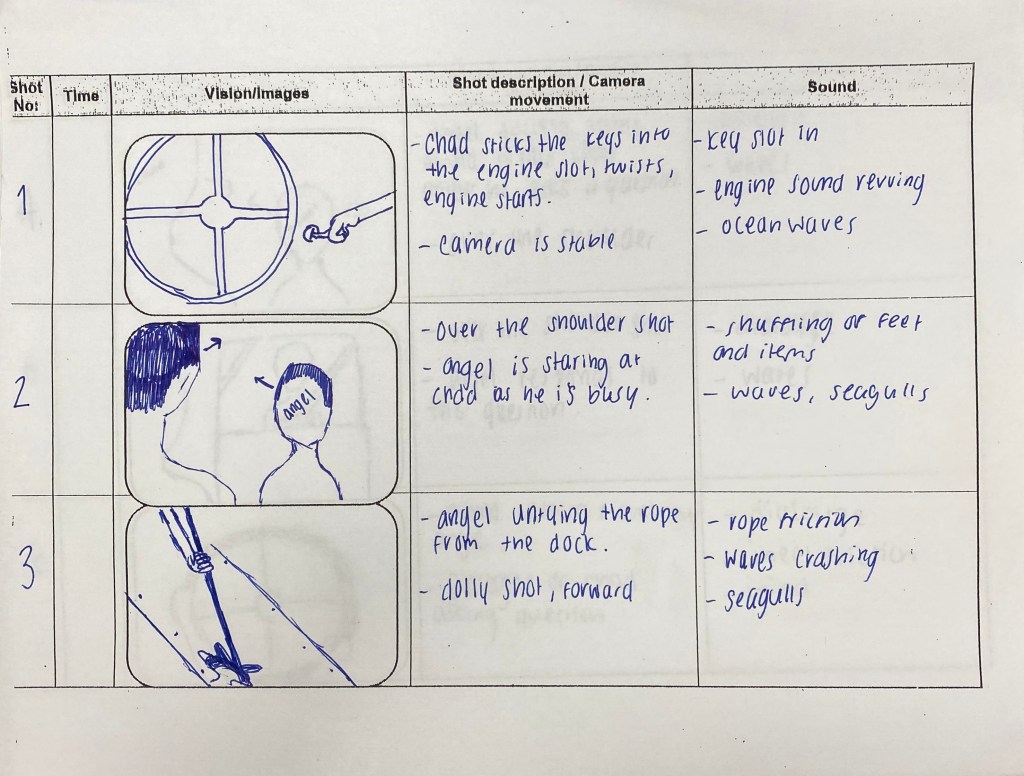
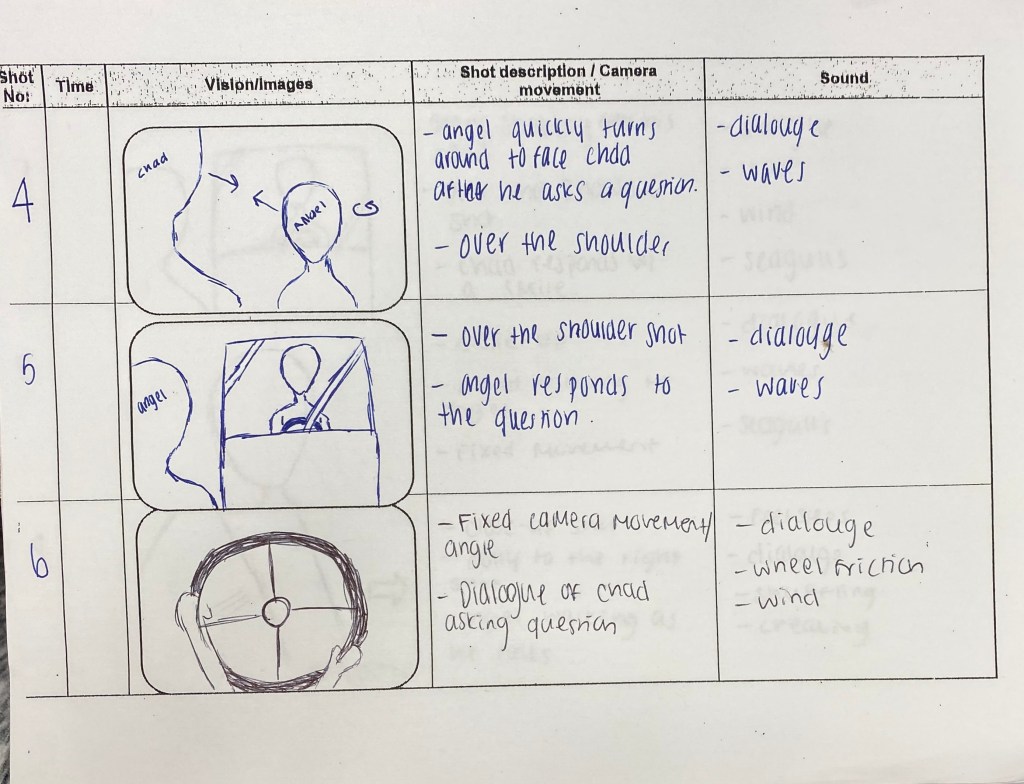
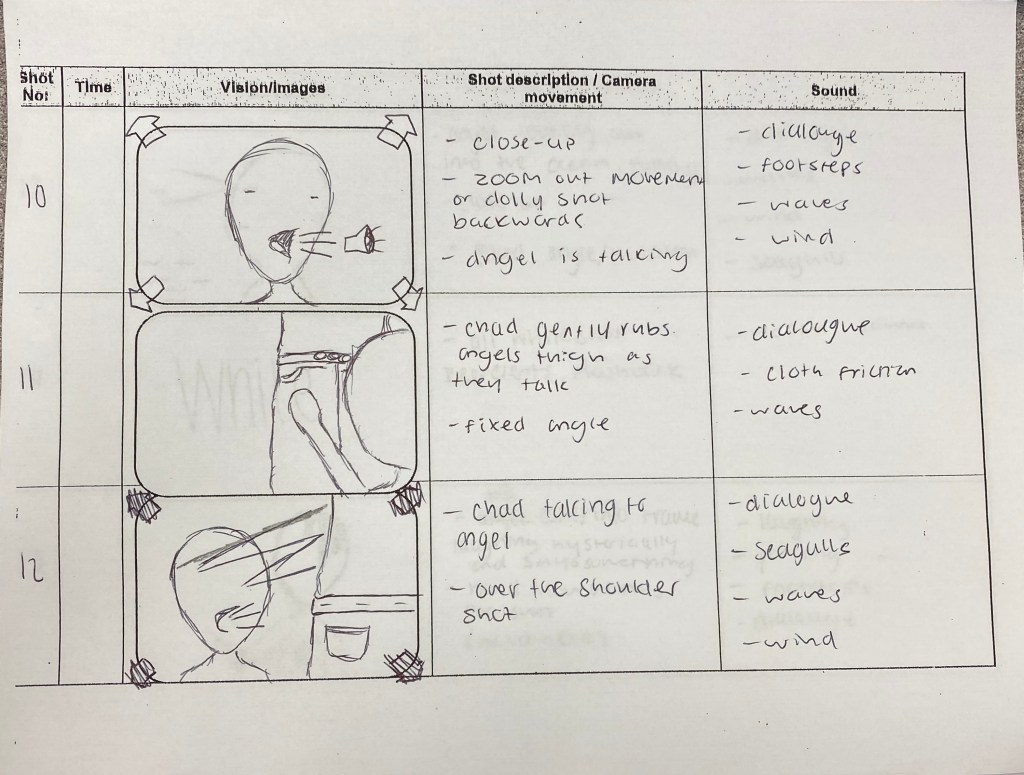
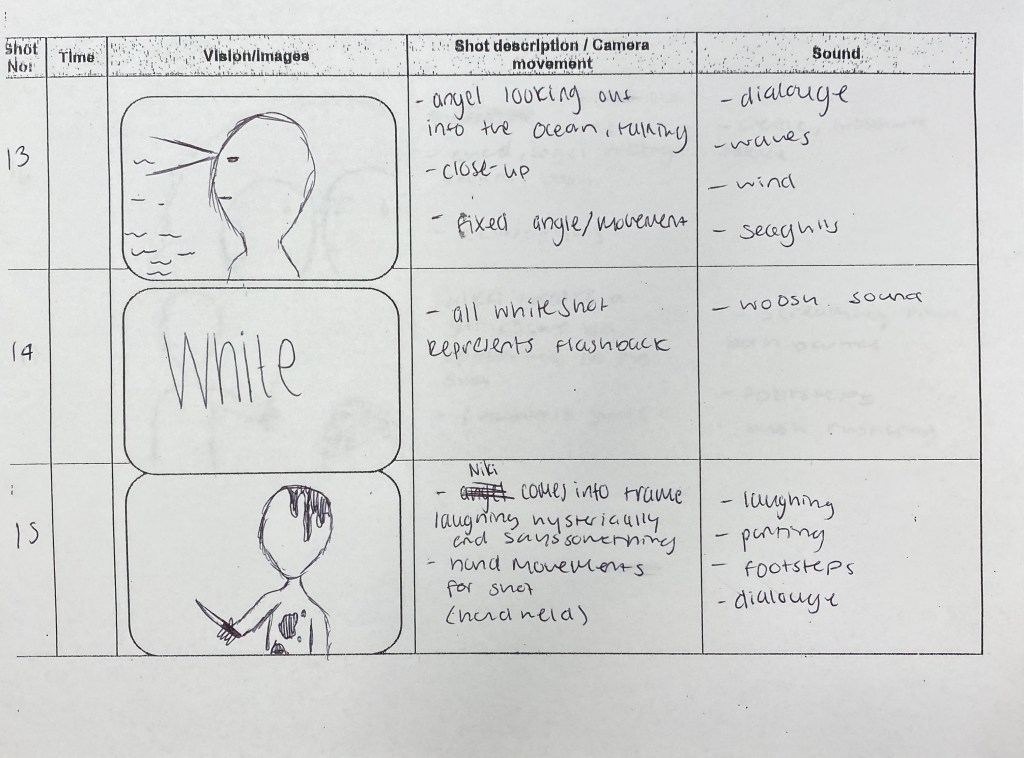
For our story board, we detailed not only each and every shot, but we also included audio and actions participating in each one of those shots. Sounds such as diegetic and non diegetic sounds were all part of the story board. This kind of illustration helps later on in post-film editing since it provides for guidelines and outlines that will guide me whilst editing.

Script – Final Film

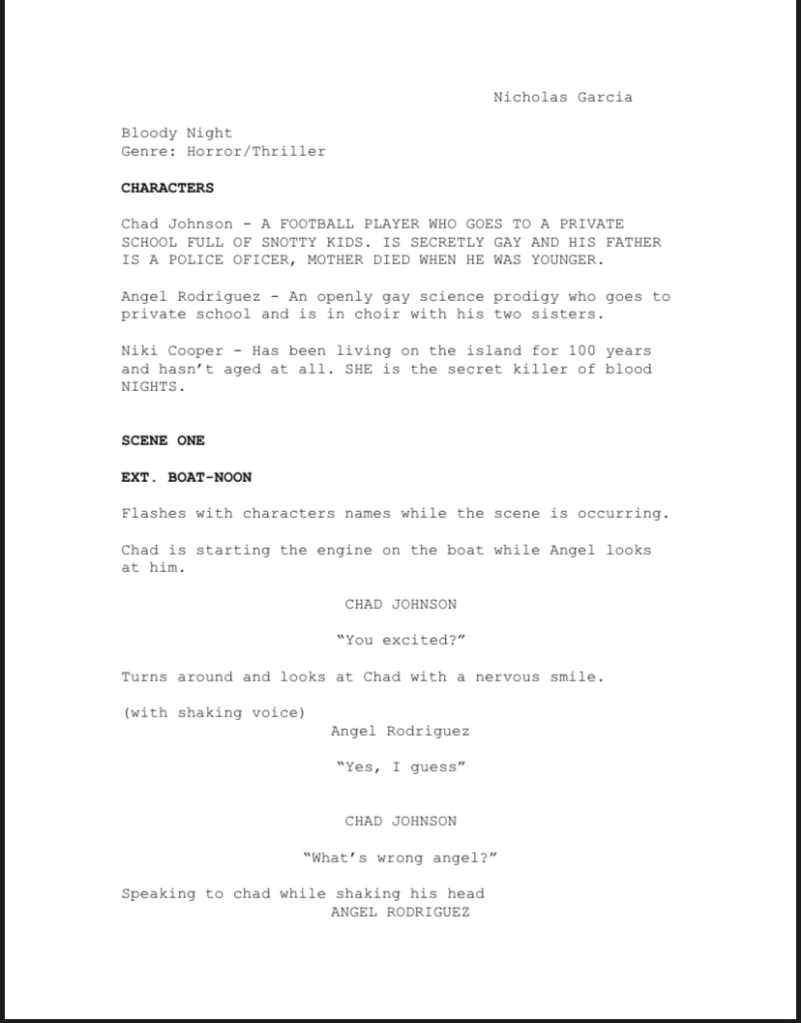
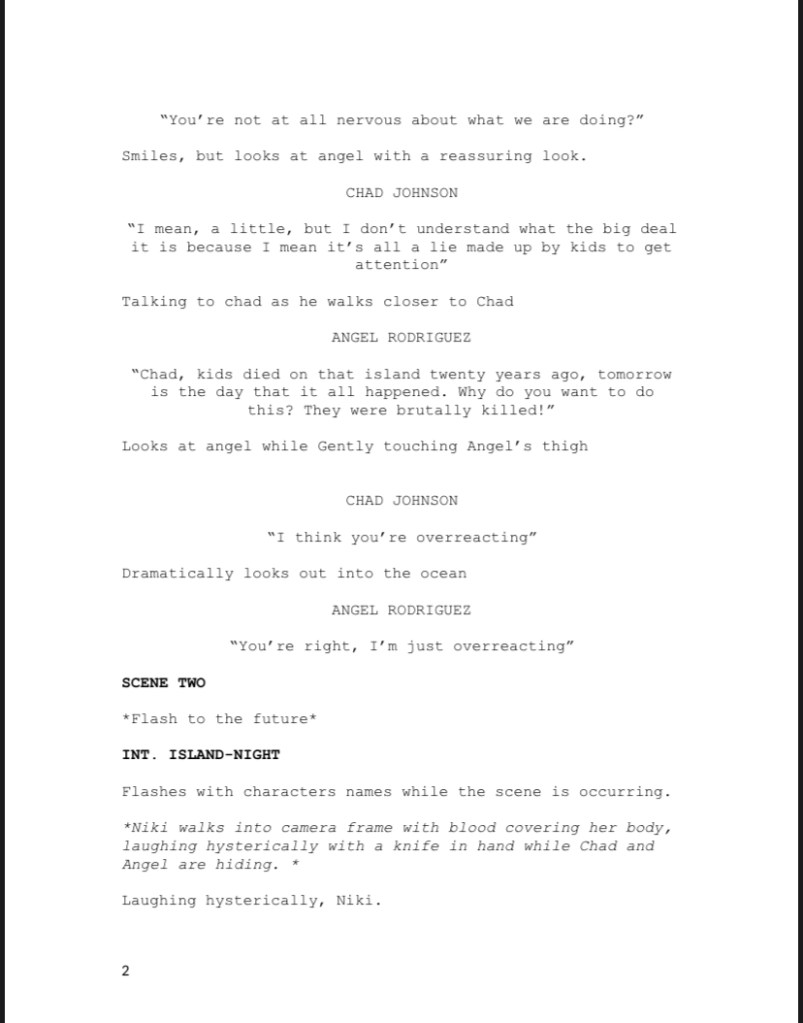
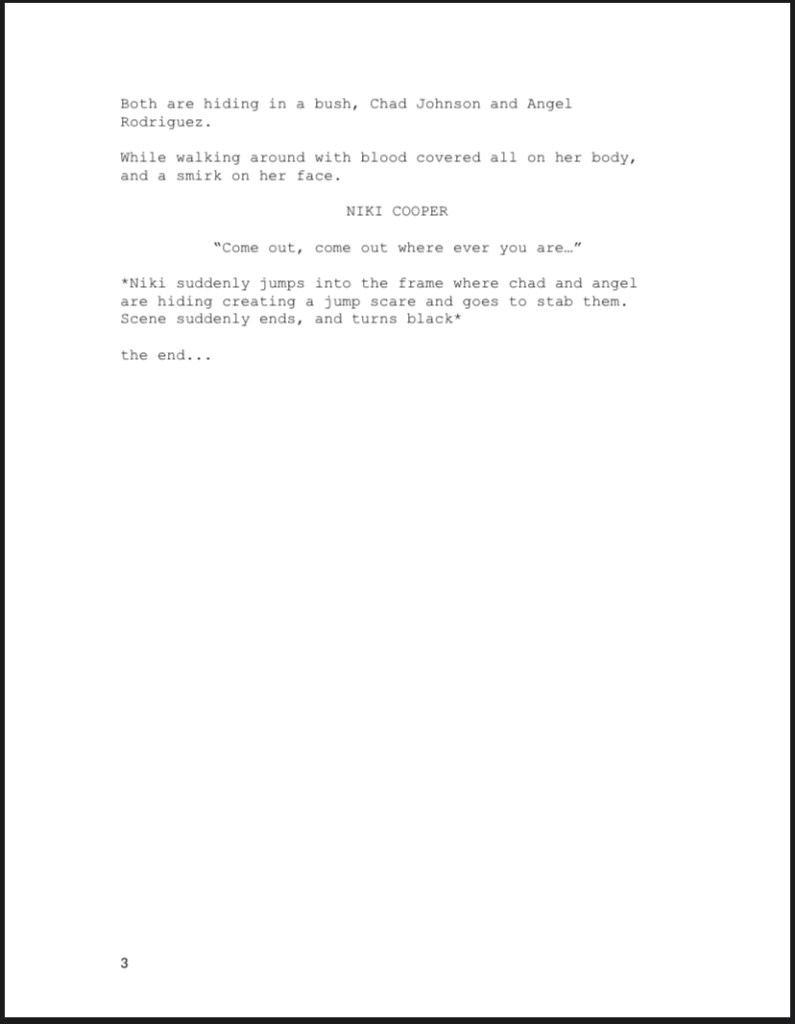
What I am doing: I am the editor for GFX, SFX and VFX on this film. This means that I will be working with the sound and visuals for this here script. The toughest part of this role that I play in the film would be the audio. Since there will be high winds in the location chosen for the film in the script, much non-diegetic sound will need to be incorporated.

What I thought was really good: I believe that our group member wrote a solid and decent script. He definitely orchestrated the characters very well and how each one of them is incorporated into the story.

What we could have improved on: The formatting of the script had to be redone and so I believe we could have still improved a little bit more on how it was all organized since there are some sports that require polishing. By doing this, we can provide a simpler, more effective method for reading and reviewing the script whilst filming and editing.

Sound in Films

Diegetic-Sound: These sounds are sounds that both the audience and character can hear. There is a multitude of ways this can be done; environmental sounds, dialogue, and sounds coming from inside the scene.

Another way to refer to this type of sound is, ‘literal sound’.

The example above is the opening scene of the movie ‘It’ (2017). The scene consists of many diegetic sounds such as rain, dialogue, and footsteps. All of these are perfect example of diegetic sound since they were shot, and recorded on scene.

Non-Diegetic Sound: Non-diegetic sound is sound that is added into a scene after it has been filmed. These sounds can include, zaps, booms, and pows. To be short, it is usually sounds thaty cannot be replicated in real life, or cheaper to add on later.

It is added in what is called ‘post-production’, or, after the filming of the scenes.

Image result for a quiet place

The above example is the widely known film, ‘A Quiet Place’. In this film, the physical villain is the creature. Since this creature is obviously done through CGI, it must use fake, inorganic sounds. That’s when fake, non-diegetic screeches are added in through editing.

Camera-Work in Horror Films

1p1HdTCOP_O8FmxJr-BL3OA

Extreme close-ups are incredibly popular among horror genre type films due to many things. For starters, these kind of shots make the audience/viewer feel claustrophobic. This kind of feeling is used to produce the feeling of anxiety and further tension.

Image result for extreme close up shot definition

Moving on to angles, a very creative and effective angle is the ‘dutch tilt’. The reason that many filmmakers use this sort of angle is because it provides an unsettling feeling mainly due to the fact that the image is unbalanced. Honorable mentions are angles such as birds-eye view and low shot angle looking up since they are also very rare and produce unsettling feelings in the audience.

Cinematography Tips For Horror Filmmakers: Unique Angles

Camera-work in Films

Image result for camera dolly shots

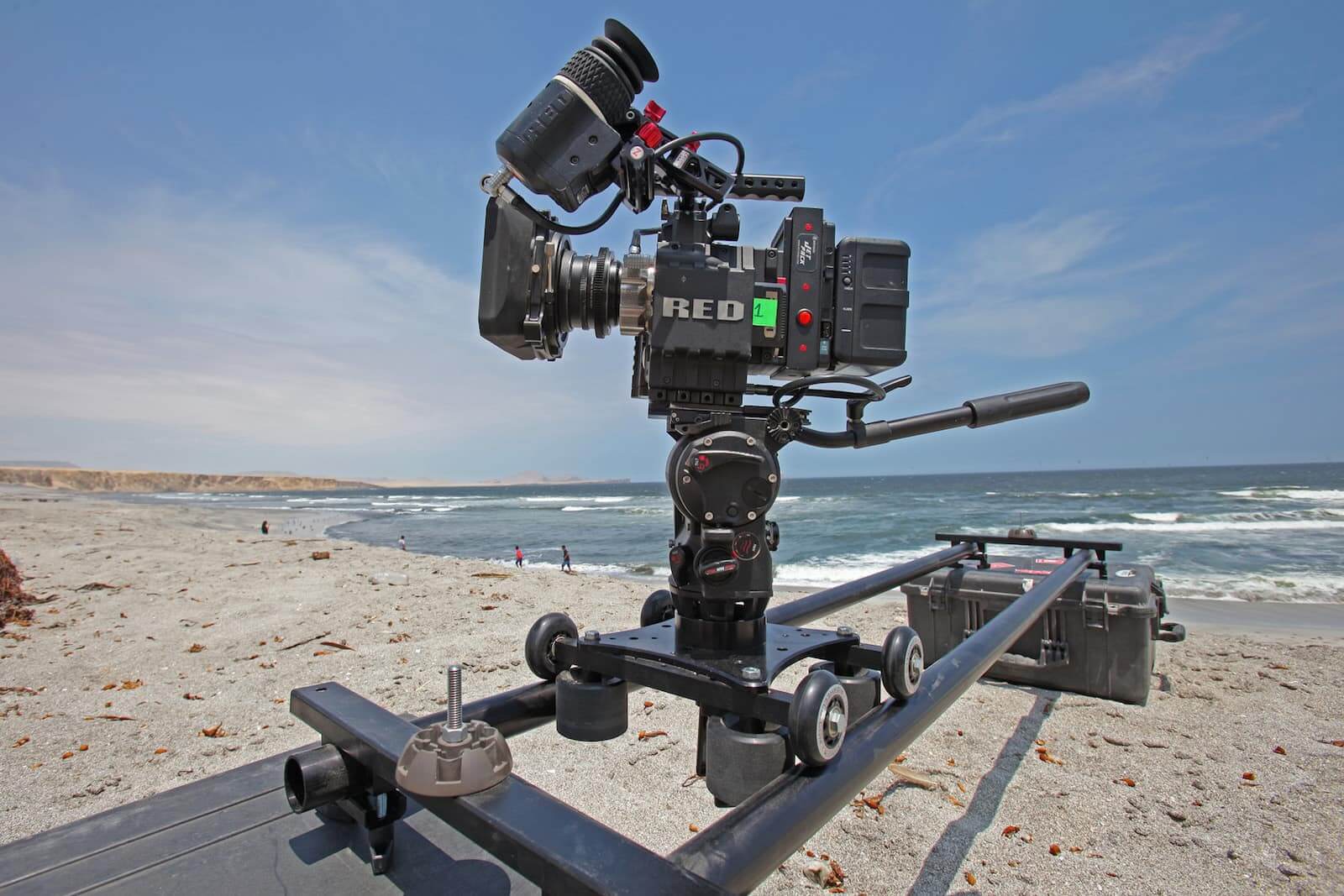
Camera-work is used in films for a multitude of reason that ranges from budget, to expression and meaning. Different genres such as Horror and Adventure can affect the kind of camera-work used since they can create and give off different feelings to the audience.

Camera Movements:

  • Zoom – Overused method, consists of in camera zooming using either mechanical or digital.
  • Tilt – The camera is kept in a stationary position, yet it is panned upwards.
  • Pan – The camera is kept stationary, yet it is panned horizontally.
  • Dolly – Camera is mounted on a track and moved along it back and forth.
  • Truck – Truck is similar to dolly shots, just that it is moved side to side rather than in and out.
  • Pedestal – It is a jib movement up and down that moves in relation to the actor.

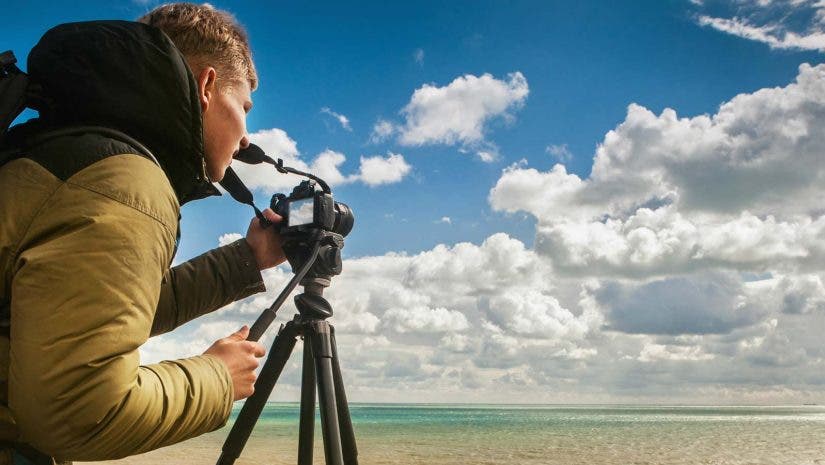
Photographer filming at the beach

Camera Shot Sizes:

  • Close-up – Used to highlight facial features of actors, camera is placed very close to actors, objects, and props.
  • Long-Shot – Opposite of a close up, shows character entire body, camera placed very far away.
  • Medium Shot – Usually shows a character from head to waist and is a mix between close up and long shots.
  • POV – Point-of-View shot, used to convey what a specific character is feeling or seeing.

Image result for close up shot definition
Design a site like this with WordPress.com
Get started